Wednesday, 28 November 2012

On the nature of light - part 2

Einstein's General Relativity
In a previous post titled "On the nature of light - part 1" I began a discussion on what a photon my look like if I were also travelling at the speed of light. Later in the post I began wondering about gravity, which is what this post is about.

Einstein realised that gravity could have some profound effects on light. Probably the best known is the bending of light near a star.

The the idea for an experiment to confirm this is one of my favourites. The most obvious large object, capable of bending light according to Einstein's theory of general relativity, is our sun. The problem of course is that it is also remarkably bright and any stars near it are lost to its glare. The solution depends on one of those truly remarkable quirks of nature, the lunar eclipse. During a full eclipse it is actually possible to see stars near the edge of the sun.

So we measure angles between stars really close to edge of the sun and some further out. We then repeat the same measurement some time later after the sun as moved round and the stars are no longer in the direct line of site. The idea being that if light is being bent then the two angles, before and after, will be different.

Bending of light (Exaggerated) 

The result was that the angles actually change and by an amount predicted by Einstein. Which is simply amazing. The explanation for this phenomena is that space-time is actually warped by gravitation fields and so the path of a light ray will also be warped. What a mind blowing idea that is!  It is particularly odd if you find yourself in a box in space.

This wasn't the only effect gravity has on light. Another absolute beauty is gravitational red shift. Imagine standing in a long lift shaft and shining a torch upwards.

According to Einstein the difference in the gravitational pull on the light is different at the bottom of the shaft than at the top. This change in gravity causes time dilation.

What this means is that two clocks, one at the bottom of the lift shaft and one at the top run at slightly different rates, even if they are identical clocks. What this means for the light shining up the lift shaft is that the frequency of the light is shifted slightly to the red end of the spectrum.

Shining the light from the top of the shaft to the bottom of the shaft has the opposite effect and in this case the light is shifted to the blue end of the spectrum, known as blue shift.

Great, so let's give it a go. There is a slight problem though, the amount of shift is very very small and is difficult to measure. The solution was an experiment by Robert Pound and Glen Rebka using an idea known as the Mossbauer effect (I'll cover this in a post of its own at a later date).

What Mossbauer had realised was that atomic nuclei can emit gamma rays that can be absorbed by a second atom of the same type. What Pound and Rebka realised was that if this gamma ray went down a lift shaft then its frequency would change just enough that it would no longer be absorbed.

They took it one step further and realised that if they moved the source of the gamma rays at a particular speed they could cancel out the shift due to gravity with a Doppler shift (I'll cover this one later as well!) and the gamma ray would once again be absorbed by the atom at the bottom of the lift shaft!

They performed these experiments using a radioactive type of iron, Fe-57, and sure enough it came out as predicted by Einstein. This was a fantastic result, and shows just how brilliant Einstein was.

Many theories try to explain phenomena that we have already witnessed by experiment. Einstein's theory not only explained what we had already seen, but went further to make predictions about things we had not seem, yet were found to be true.

In a way this is what makes things both interesting and difficult in physics. General relativity has been tested by experiment and found to be true. So has quantum mechanics. Quantum Electro Dynamics (QED) has been tested to a higher degree of accuracy than any other theory. The problem is that it has not been possible to reconcile these two different theories. One works on the macro, the other, the micro.

So, we were discussing the nature of light and somehow we have staggered into gravity! Really, this is the point of this post. Irrespective of the physical phenomena, bending of light, red or blue shift gravity, gravity has an observable effect on light. Which means that it must be having the same effect on individual photons of light.

Now it can be argued that gravity is distorting space time and it is this distortion of space time that we are observing when we look at how light is effected by gravity.

I am not completely convinced by this and the reason is that I don't think it is possible to separate out space-time and light. I think that the two are intrinsically linked. It will be this link that I will be covering in the next post on the nature of light. It is this link that I think shows that light must have a gravitational component.

Then again, I could be completely wrong!

Sunday, 25 November 2012

On the nature of light - part 1

Gravity waves, I think not.
Years ago I read a book that said that Einstein had once pondered what a wave of light would look like if you were travelling along side it. Now we know that light is an electromagnetic wave that and can be described by Maxwell's equations. 


Einstein, so the story went, started looking for solutions to Maxwell's equations that would describe a stationary light wave, and found that there is none. This lead him to do some serious pondering that brought him to the Special Theory of Relativity. A serious result! For me though this was a bit of a sad ending.

For many years I have imagined light travelling through space in a kind of spiral motion and I wanted to know what would happen as I got faster and faster until I was chasing the photon at the speed of light. I know that I have mass and so I am forbidden from travelling at the speed of light, but say I was a photon and so I was a photon chasing a photon, I have always wondered what would it look like. In addition to looking at the photon ahead of me, what would I see if I actually stopped and had a look at the universe

Now I know there is no point in going back to Maxwell's equations because Einstein, a far finer mind than my own, had already been there and discovered there was nothing doing. So that was out, then I got thinking about Louis be Broglie. I have always had a soft spot for de Broglie if only because a physics teacher of mine was really jealous of this guy for some reason I never understood. 

Louis came up with the idea of wave-particle duality, giving us this equation


where
is the wavelength,
is the Planck's constant,
is the momentum,
is the rest mass, 
is the velocity
is the speed of light in a vacuum. 

If we consider a photon, the value of   is  and so the equation brakes down since   becomes zero. If your maths is a little weak, this is because the last part of the equation, the  /  part becomes 1, and 1 - 1 = 0, and anything multiplied by zero is zero. So   becomes zero. 

We know that electrons can behave like waves and photons can behave like particles.

So back to my photon, I think that if I am travelling at the speed of light directly behind my friend the photon I see the photon as a type of standing wave. If the wave is travelling in the x direction then the standing wave exists in the y/z plane.

Conventional thinking is that the magnetic field induces an electric field and the electric field in turn induces the magnetic field and it is by this mutual induction that the photon travels through space (see equations 2 & 4 below for the mathematical representation of this sentence!). This seems to be the way, but I can't help thinking there is more to it than this and I'll explain why I think this.

Gravity.

We know, from experiment no less, that light can be bent when it passes by a star. This was what pushed Einstein to public fame because he had predicted this. The light bends because space time is bent and light just travel along the most direct route. This is gravity at work.

Fine, but here is the thing I think that light as an additional component to the electric and magnetic fields. I think there is another component, gravity.

I have several reasons for thinking this, though the first is that gravity waves, if they exist, travel at the speed of light. Just like light. I just find it too coincidental that gravity waves and light waves both travel at the speed of light. Now you can argue that the theory of  general relativity is derived using the speed of light as a constant and that the speed of gravity waves comes out of this. I would turn this around and say that the reason gravity waves travel at the speed of light is that they are actually a component of light.

Gravity waves have never been detected, I find this amazing given the amount of effort that has gone into actually finding these fellas. Maybe we are looking in the wrong location and in the wrong way. I think that there are gravity waves but they are different to what we actually think. More on this in the next post.

So Maxwell's equations, now I know I said that I was not going to go anywhere near these. After all, finer minds than mine have already gone down this road and found it a dead end, but I can't help thinking I just need to take a quick look.

Let's consider the Maxwell equations for an electro magnetic wave in free space. It goes something like this,


don't worry about the meaning of these at the moment, we will cover them in the next post. My point in actually listing them is so that I can point out that there is something else. See I think there is an extra term that needs to be added to these equations to represent gravity.

But! I hear you cry, photons, don't have mass, so it doesn't make sense to even consider gravity here. I think this is were we have are going wrong, and in the next post on the nature of light, I'll show you why.

To finish this post though I want to point out a few "similarities" between gravity (G) and electromagnetism (EM).

EM - Coulomb's law. F = qE
G - Newton's law F = ma

G and EM both act in a vacuum
Both obey the inverse square law (more on this next time, suffice to say they both have an inverse square law).

True there are a number of differences.

Gravity is always attractive, particles with similar charge repel each other.
Electromagnetic forces are considerably larger than gravity IF we compare the electro static repulsion of two electrons with the gravitational attraction, based on existing theories.

I think we need to explain the differences and also explain the similarities, and this I will try to do in my next post.

Coming soon to a cinema near you!

Monday, 19 November 2012

Radioactivity

Marie Curie - winner of two Nobel prizes
Recently I did a bit of a general post on atoms and atomic nuclei, which got me thinking about radioactivity and nuclear magnetic resonance (NMR). The first of these, radioactivity, I am going to post about here, the other, NMR, I'll do in a post shortly.

While Rutherford was undoubtedly one of the great contributors to the study of radioactivity, I think that the most famous must be Marie Curie, Nobel Prize winner in both Physics and Chemistry, the only person to win two prizes in the sciences.

Curie discovered polonium and radium. These elements provided Rutherford with the materials he need to do his great works. She came up with the name Radioactivity. She was also instrumental in the development of the use of X-rays in medicine. The Red Cross actually made her head of its radiological service.


Today there are numerous schools and institutes bear her name. Her research and long term exposure to radioactive substances would eventually cause her cancer that would ultimately kill her. Cancer research and cancer charities now carry her name.

Albert Einstein once remarked that she was probably the only person not corrupted by fame. What a superstar!

Marie Curie I think you are great.

I also think Radioactivity is great because it features the nucleus of the atom, that magnificently tiny speck at the centre.

Apart from Hydrogen, which is a bit of a special case in many ways, all nuclei consist of combinations of protons and neutrons. It is the protons in the nucleus which determine what element we are dealing with. For example, any atom with 6 protons in the nucleus is Carbon. If it had 7 protons it would not be Carbon, it would be Nitrogen.

Carbon typically has 6 protons and 6 neutrons, but it can have 8 neutrons, this is C14. Nitrogen usually has 7 protons and 7 neutrons, so it is N14. N14 is very similar in mass to C14, but it is the difference of just 1 proton that changes everything and gives us two very distinct elements. There are NO two elements with the same amount of protons. Though there are some with the same amount of neutrons.

Isotopes are variants within a single element, by this we mean that an element can have atoms with a different number of neutrons, eg Carbon 12, Carbon 13 and Carbon 14 are said to be isotopes of Carbon.

Some isotopes are found to be unstable and are known to be radioactive. They can undergo a reaction resulting in particles being ejected from the nucleus. The most common types of radiation, are alpha, beta and gamma radiation. There are certainly more than this, including proton emission and neutron emission.

The names alpha, beta and gamma are from the Greek alphabet and were used by Rutherford and Villard to describe the different types of radiation they had witnessed in experiments. At the time they had no idea what they actually were. It took Rutherford 7 years to prove that alpha particles were actually the same as a Helium nucleus. The beta particle was known to be far more penetrating than the alpha particle, but again it took a considerable time to prove it was in fact and electron.

The realization that a beta particle was an electron was a major discovery because it showed that electrons can originate from a nucleus, even though a we know that the nucleus only contains neutrons and protons. This in turn lead to the idea that a neutron can decay into a proton and an electron that is then ejected as a beta particle.


It was Villard who discovered gamma rays while studying radium in 1900 and it was Rutherford who gave it its name in 1903, these are not particle but are high energy light waves, so energetic that they can go through a fair amount of lead shielding!

The discovery of radioactivity and its associated properties lead to a rather astonishing idea and it was that it should be possible to use this behaviour to calculate just how old the earth is! The idea was dreamed up by Rutherford, who you may have gathered was a bright chap, in 1905, the same year Einstein was publishing is ideas on Special Relativity.

Rutherford realized that radioactivity was due to some atoms changing into lighter elements and emitting alpha, beta or gamma radiation. They also discovered that particular "isotopes" of a specific element decay at a distinctive rate, now called its half life.

Imagine you had a billion atoms of Uranium 235, the half life is the time it takes for 0.5 billion of them to decay into something else. It turns out that Uranium and thorium have very long half lives and so stay for long long periods, which is why they are so difficult to manage when we take them out of nuclear reactors.

Rutherford figured that it may be possible to work out the age of the earth from the relative proportions of radioactive materials in rock samples. This is slightly trickier than you might think because some of the particles that are produced by the radioactive process are themselves radioactive and decay! So you end up with a sort of family decay tree, with parents, children, grand children and so on.

In the following 50 years this method was investigated and refined, there are about 40 different techniques that have been used working with a fairly large variety of radioactive materials.

The results put the earth at about 4.5 billion years old. Which is only about 1/3 the age of the known universe, but similar in age to the sun, it was thought to have formed within 100 million years of so after the sun.

100 million years! You pop it in a sentence as if it is nothing, but think about that for one minute. 100 million years after the sun fired up with think the earth formed. The earth has been here for about 4.5 Billion years! the is a period of time that is just so far beyond our imagination.

Atoms on earth have been undergoing radioactive decay for about 4.5 billion years. That is loads of atoms undergoing loads of decay and it is still going on. We still have radioactive elements in the earth. For all that time, this process has been going on and on and on.

It really does stagger my brain. I think I need to go for a lie down!

Monday, 12 November 2012

twisting the light away

Twisted light
Most people these days know that light is made up of photons, while we are still a little vague on what a photon actually is, we know that light is made up of them. It is the most basic unit of light, we think.

Light, has no mass, but does have energy and more importantly to this post, it has momentum. In fact, you can use this property of momentum to help derive Einstein's most famous equation E=mc2. A photon actually has two components of momentum. The first is one that many are familiar with, spin angular momentum, or polarisation to you and me. It is the polarisation of light that allows us to make some really clever things like 3D TVs using 3D glasses.

It also has something called orbital angular momentum, the earth going round the sun as orbital angular momentum, which some people think is a good analogy. Can't say as I do, because I can't see what the photon is orbiting!

Anyway, this property of orbital angular momentum (OAM) as got everyone in a bit of a spin because if it is in fact true, then there may be a really clever way of using this property to transmit loads of information. Which would come in very handy, mainly because we are currently running out of bandwidth.

The problem is that lots of people have lots of smart phones that can download lots and lots of information. As demand for higher definition images and faster download speeds increases the available bandwidth shrinks and shrinks and will at some point run out. May be not...

OAM potentially offers the ability to reinvigorate bandwidth, if the theories are correct there is the opportunity to tap into a massive reservoir of bandwidth which will keep us happy for at least a couple of years. Not everyone believes this is true though. Some physicists do, particularly those currently doing research in the field, others don't.

An experiment, a very public one, sent data across a Venice lagoon at a tremendous bit rate. There is little doubt about the transfer rate, up in the gigabit range. What I find really interesting is that some of the detractors think that the interpretation of the experiment is wrong. They don't think we are seeing OAM, they think we may be seeing something called Mimo, multiple input multiple output transmission. Mimo has been around since the 70s and some of the latest WiFi technologies, the 802.11n, type that you get in your latest routers exploit this technology.

So who is right, and how can anyone actually get this wrong? after all wouldn't it be obvious? Well, this is were it all gets a little human, shall we say. The Physicists involved are saying the engineers don't understand the physics. The engineers are pointing out that when it comes to telecommunications the physicists don't understand and that this is nothing more than telecommunications.

In fact the engineers go a step further and say that all the physicists did was replicate Mimo and if they try to extend their work they will realise that it does not work as expected, because it is not OAM.

We shall see.

While I feel a certain allegiance to the Physicists can't help thinking the engineers may be right on this one. Maybe that is because I haven't read that paper on Poynting's vector, I'm going to read it now and will get back to you later.

Tuesday, 25 September 2012

Elements

The Periodic Table
Just about everyone is familiar with the image of the periodic table.

Even the name is familiar, you say "periodic table" to some one and chances are, providing they have had some education, they are likely to picture something that looks a little like the image to the left.

I have always loved the periodic table, when I was a kid and I first saw one in a class room I was instantly struck by just how beautiful it was. In those days there were 103 elements, the last being Lawrencium named after Ernest Lawrence the Nobel prize winning physicist who had quiet a lot to do with radioactivity. These days there are more than 112, the last being Copernicium.

Livermorium at 116 has been added as of May 2012, so far 35 atoms of Livermorium have been produced in the 12 years since it was first discovered!

The periodic table as it is now was first dreamt up by Dmitri Ivanovich Mendeleev and presented by him in 1871, it looks a little different to the modern day, but that is partly because there were only 56 known elements at the time.


What fascinated me about the periodic table was that it listed each and every element that makes up the known universe. All in one little table. Each element having one more proton than its predecessor. The elements are stacked into rows consisting of 2 elements, H and He, then 8, that's Li through to Ne, then 8, then 18, then another 18, then 32 and finally the remaining 25 to make a total of 112. If we get as far as element 118 then chances are we will have to start a new row.

Carbon, which gives us diamonds the hardest known material, sits right next to nitrogen which is a gas! Yet the differ by only a single proton. Potassium, the highly reactive metal that burns with a purple flame has only one more proton than Argon, a gas. Some of the elements become superconducting when cooled, others do not. Some are great at carrying electricity, others are semi conducting or have insulator properties.

The chemistry of the elements seems to be governed by the number of electrons each atom has around it, this is governed by the number of protons, the number of electrons being equal to the number of protons in electrically neutral atoms. While this makes sense in a way, it is still quiet staggering when you consider the differences between the different elements.

Some elements have radioactive isotopes which means that can undergo some form of particle emission from the nucleus and turn into another element. Some of the large atoms, Uranium for example can decay into two elements!

What I also find completely mind blowing is that apart from Hydrogen and Helium, which we currently believe have been here since the beginning of the universe, and excluding those that have been made in the lab, the rest were actually made inside stars.

Every atom that makes up our bodies is listed in the periodic table. We are mainly made from Hydrogen that has been here since the beginning of time. There may be atoms in your body that are 13 Billion years old and were there to witness the birth of the universe (that is if the Big Bang theory is correct!).

How cool is that, to think that we contains atoms of Hydrogen from the very beginning of the universe. Know wonder there are some days I feel old, it's because my constituent parts are really, really, really old.


Tuesday, 11 September 2012

Beta emissions and quarks, really?


Up becomes down and out comes a positron
All atomic nuclei are made up of different numbers of protons and neutrons, the different combinations of protons and neutrons give us the elements and their isotopes.

Radioactivity is the emission of particles from the nuclei of atoms.


Of all the different types of radiation, I think my favourite is probably beta emission and it is this I am going to talk about in this post.


Beta emission is where an electron, or a positron, is ejected from the nucleus of an atom. Now for those of you paying attention, I am sure you have just raised an eye brow and thought, "hold on a minute, you said that the nucleus is made up of protons and neutrons, no mention of electrons there!" and this is absolutely true. There are NO electrons in the nucleus of an atom. None whatsoever and yet, they can still be ejected from the nucleus!

I think this is absolutely fantastic.

Many believe that we can view a neutron as a proton and an electron bound together. By that logic, positron emission, the emission of a positively charge electron, implies that a proton is a positron and a neutron bound together. This is not right.

The current thinking is that protons and neutrons are actually made up of quarks. This is part of the Standard Model, which appears to have had a rather spectacular result recently with the discovery of the Higg's boson.

Quarks can change and as a result of this change electrons or positrons can be produced that come whizzing out of the atomic nucleus.

Take Fluorine 18, this has 9 protons and 9 neutrons. The stable form of fluorine is fluorine 19, 9 protons and 10 neutrons. The extra 1 neutron in fluorine 19 makes it a happy bunny. But fluorine 18, completely unhappy and it shows this by kicking out a positron, like so

18F -> 18O + e+

one of the protons has changed to a neutron, so only 8 protons remain, and the 9 neutrons become 10, making it an Oxygen atom. Oxygen 18 is also a happy bunny and does not decay any further.

So, this is the thing that I am going to be pondering for the next week or two, Fluorine 19 - happy, Fluorine 18 - unhappy, Oxygen 18 happy. One neutron difference between F19 and F18 is enough to make the second, F18 unstable. It seems that the neutron has a calming effect. Will ponder this in a later post.

Now, to finish, fluorine had 9 protons and 9 electrons to balance it out. Oxygen, the final product, only has 8 protons so only needs 8 electrons to balance it out and make it electrically neutral. So what happened to that extra electron?

Well, maybe, the positron, which is the anti particle of the electron, interacts with the extra electron to form something that we could call positronium. The two particles could then annihilate each other and decay into gamma rays.

Now that would be really cool.

Sunday, 9 September 2012

Size of an atom

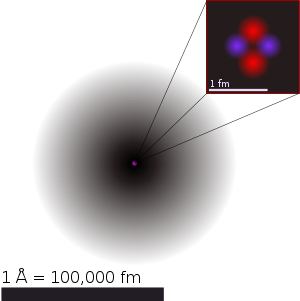
Helium nucleus surrounded its electron cloud
The size of the atomic nucleus is an absolute wonder to me. Atoms are incredibly small and yet they are massive compared with the size of the nucleus. When I was a kid I once read that if an atom of Helium was the size of the Albert Hall in London, then the nucleus would be about the size of an orange.

The size does vary according to the atom in question, Uranium atom nuclei are about 8 times larger than a hydrogen nuclei, which only contains a single proton. The largest come in at about 15 fm (Femto metres).

15 fm is tiny, it is about 10,000 times smaller than an atom, and this is why people often say that atoms are mostly made up of nothing. I think this is wrong. Atoms cannot be any smaller than they are, you cannot make them any smaller. You increase the pressure and eventually atoms will collapse into neutrons, this is what we believe happens in neutron stars. They do not collapse into smaller atoms.

So I think that they are actually as full as they possibly can be. They are full to capacity, which got me pondering to what they are actually full off.

Take the hydrogen atom, a single proton and a single electron. The proton is tiny and the electron is also very tiny. They carry equal but opposite charges. The proton is about 1830 times the mass of the electron. The interact to create the hydrogen atom. They both spin. This leads us to imaging the proton like a large planet with a small satellite, the electron in orbit around it, which is wrong*, but looks nice.

The size of the hydrogen atom is about 0.03 nanometers, which is huge compared with either the electron or the proton, yet this is the smallest it can possibly be.

The best explanation we currently have for the behaviour of an atom comes from quantum mechanics (QM). I have been told that the Heisenberg Uncertainty Principle (HUP) explains why the electron, which is negatively charged, does not drop straight into the positively charged proton to form a neutron, after all opposites should attract.  I've never really understood or been convinced by the argument, seems a little odd to me. That said

Atoms do change size as we move through the period table, Hydrogen is the smallest and the largest has a radius almost 10 times the size of Hydrogen, which is comparable to the change in size of the atomic nucleus for the two extremes. Is this coincidental or is there something in this?

The reason we think the atoms change size is due to the electrons having to pack in around the atomic nucleus. Hydrogen has a single electron so it is small, Uranium has a whopping 92 electrons surrounding each atomic nucleus, so it is larger!

All atoms are small compared to the wavelength of visible light, which is about 1000 times bigger, which really baffles me, because visible light should not be able to see something as small as an atom, and yet interactions occur between visible light and atoms. Just take a look in the mirror! This is just visible light striking atoms and being reflected back.

The interaction of light and atoms is currently explained by Quantum electrodynamics or QED for short. A brilliant theory that has been tested over and over and has come through time and again. Something I will cover in another post.

So what is the point of this post?

Atomic nuclei are typically 10,000 time smaller than atoms, which are in turn 1,000 times smaller that visible light. So from visible light to atomic nuclei that is a change is scale of 10 million. Let's see if we can get that in perspective. Imagine a ball with a diameter of about 1 metre then the wavelength of light would be comparable to the width of the planet earth. Which is once again, too big for us to image.

I suppose the point is, than even on tiny scales, those of visible light, atoms and nuclei, the distance from the largest to the smallest is absolutely massive and is so big to be beyond our imagination.

What I still can't figure out is why atoms are the size they are and why nuclei are the size they are, why approximately 10,000 times, why not 50, or 5,000,000? will have to ponder, when I come up with something I'll let you know.


more like this

Related Posts Plugin for WordPress, Blogger...